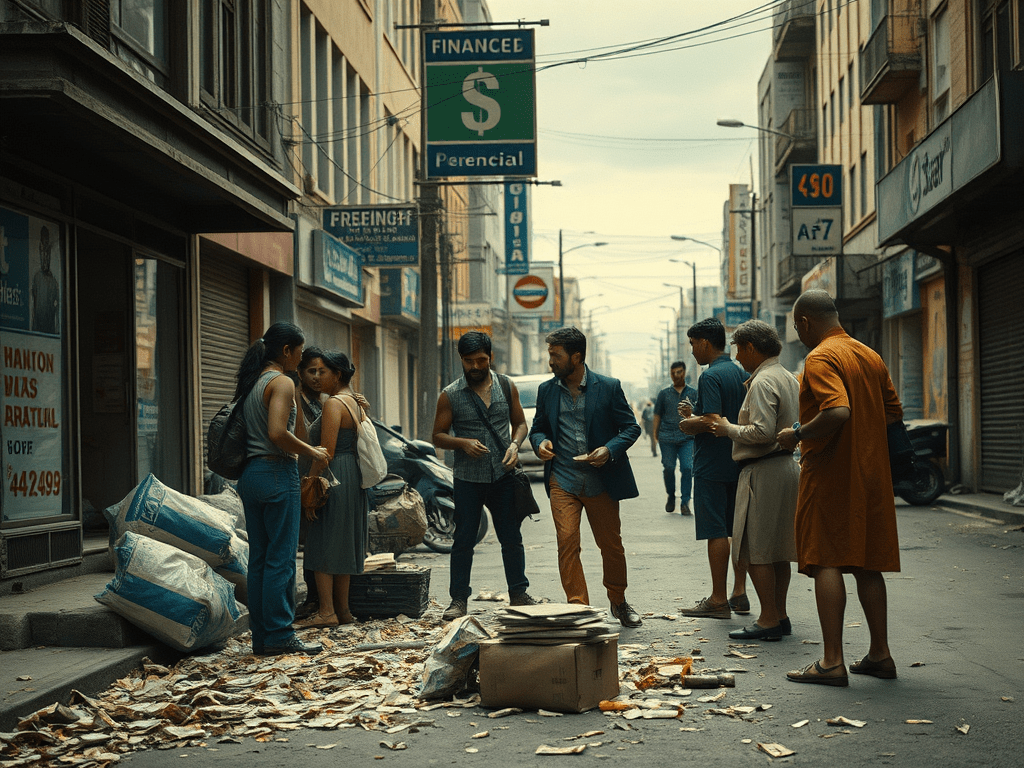
The Collapse of Institutions
In a scenario where the world undergoes an apocalyptic event—be it a collapse of governments, widespread natural disasters, a global war, or a financial system failure—the institutions that normally regulate money and trade would cease to function. This includes:
- Governments: No longer able to issue currency, enforce laws, or maintain order. Without the ability to back or control the value of money, traditional national currencies would quickly lose value.
- Banks & Financial Institutions: With no institutions to process transactions, enforce contracts, or provide stability, digital bank accounts and credit systems (like credit cards) would become useless. People could no longer rely on electronic transfers or access savings.
- Supply Chains: With global trade networks in disarray, the flow of goods—especially essentials like food, medicine, and fuel—would become erratic. The long and complex global supply chains that feed modern economies would break down, further isolating communities and making money-based transactions increasingly impractical.
The Breakdown of Traditional Currency
In this new world, currency ceases to be a reliable store of value. Why?
- Loss of Trust: Money relies on trust—trust in a government or institution to uphold its value. If those institutions are no longer operational, that trust disappears.
- Scarcity of Resources: In an environment where basic resources are scarce and survival becomes the priority, the value of abstract concepts like “money” becomes irrelevant. Paper bills or digital funds become meaningless without real, tangible goods to buy.
Barter and Trade
Without functioning currency, societies in a post-apocalyptic world would likely revert to bartering. Here’s how the system might evolve:
- Immediate Utility: The things people trade would be directly tied to survival. Food, clean water, medicine, tools, and fuel would become the currency of the new world. These are items with immediate utility, and their value is clear and direct. A bottle of water might be worth a packet of seeds or a piece of livestock, for example.
- Skills and Labor: In addition to physical goods, people might also trade skills and services. A mechanic might repair a generator in exchange for food, or a farmer might give away produce in exchange for a defense expert providing security from raiders.
- Local Economies: Trade would likely become more localized, with people relying on their immediate environment for goods. Towns and small communities could form their own “micro-economies,” where people are self-sufficient but still exchange resources on a local scale. This would encourage regional barter systems rather than the globalized exchange systems that exist today.
What Becomes Valuable?
In this new economy, the things that become valuable are often the most basic necessities for survival. These can include:
- Water: Clean, potable water would be extremely valuable in a world where access to fresh water becomes scarce. Water could become a form of currency in certain areas.
- Food: Non-perishable foods, seeds, livestock, and agricultural knowledge would be highly prized, as the ability to grow or gather food becomes a crucial skill.
- Shelter and Security: Building materials, fortifications, and security services (armed guards, surveillance, etc.) would be in high demand. Protection from dangers like other survivors, wildlife, or the environment itself would be essential.
- Medicine: Pharmaceuticals, first-aid supplies, and knowledge of medical practices would become essential. People with access to medical knowledge or the ability to provide treatment would be highly sought after.
- Fuel and Energy: Solar panels, batteries, gasoline, and other energy sources would be crucial for powering everything from homes to vehicles. In areas where electricity is scarce, the ability to generate or find fuel could provide significant value.
- Weapons and Tools: Firearms, knives, and basic tools would become essential for self-defense, hunting, and survival. They would be highly traded for their utility in ensuring safety and providing for basic needs.
The Role of Precious Metals
In some scenarios, people might turn to precious metals—like gold, silver, or even rare minerals—as a form of trade. These materials have intrinsic value, and they’ve historically been used as a store of wealth. However, in a world where survival takes precedence, the actual usefulness of these items might be limited compared to resources like food, water, and tools. Nonetheless, people may hold onto them because they are universally recognized as having worth and might be used to trade for larger quantities of essential goods.
Social and Economic Structures
In a post-apocalyptic world, the absence of traditional money could lead to a more decentralized, fragmented society. Without a central authority to regulate transactions, the rules of exchange would be informal and determined by individuals or groups. This could create:
- Barter Communities: Local communities might develop barter economies, where everyone trades goods or services based on their needs. These systems are more flexible but can also lead to exploitation if one party is in a more powerful position.
- Power Struggles: The scarcity of resources could lead to intense power struggles. Strong groups could dominate weaker ones, and “money” could be replaced by control over critical resources (e.g., water, weapons, or medicine).
- New Forms of Currency: Some groups might attempt to introduce alternative forms of currency, like tokens, coupons, or even digital currencies based on blockchain technology (if the infrastructure allows). However, these would only be valuable within specific communities that agree to recognize them, and they’d likely face significant challenges in terms of trust, security, and acceptance.
The Psychological Impact
The loss of money could also have a deep psychological effect on survivors. Money, in its modern form, is a representation of status, security, and future planning. In a world where these concepts no longer apply, people would need to adapt quickly to a new reality. Some might struggle with the loss of long-term planning, while others could find solace in a more immediate, practical approach to life.
In sum, the end of traditional currency in a post-apocalyptic world would be marked by a shift to resource-based economies, bartering, and a redefinition of value centered around survival and immediate utility. The survival of communities would depend less on financial capital and more on tangible goods, skills, and the ability to protect oneself in a world where the rules of commerce have radically changed.
 inTHEknow